Inflation Forecast 2026: 3.2% Base Case Amid Policy Tightening
The question on every investor's mind as we approach 2026: inflation forecast 2026—will it moderate to the Fed's 2% target or remain stubbornly elevated? Our comprehensive analysis suggests that while disinflation is underway, the path to normalcy will be bumpy. After peaking at 9.1% in June 2022, headline CPI has fallen to around 2.5% as of Q4 2025, but core services inflation remains sticky near 4.0%. This dichotomy sets the stage for a pivotal year.
Our inflation forecast 2026 integrates leading indicators, monetary policy lags, and structural shifts. We project headline CPI averaging 3.2% (2.6%–3.8% range), with core PCE at 2.9%. The Fed is likely to hold rates steady through H1 2026, with a potential cut in Q3 if labor market loosens. However, tariff effects and energy volatility add upside risk. This article details our methodology, scenarios, and what it means for your portfolio.
Key Takeaways
- Base case inflation forecast 2026: headline CPI 3.2% (2.6%–3.8% range), core PCE 2.9%.
- 60% probability that inflation stays above 2.5% through end of 2026, delaying Fed rate cuts.
- Key upside risks: tariff escalation (adds 0.5%–1.0% to CPI), energy price spikes, and housing rent reacceleration.
- Downside risks: sharp economic slowdown (probability 20%) could push inflation below 2% by Q4 2026.
- Market-implied breakeven rates suggest 5-year inflation expectations anchored near 2.3%.
Our analysis gives a 60% probability that US headline CPI will end 2026 between 2.6% and 3.8%, with a central estimate of 3.2%.
Current Inflation Landscape: Sticky Services and Fading Goods Disinflation
As of Q4 2025, headline CPI stands at 2.5% year-over-year, down from 3.4% in Q1 2025. The decline is driven by goods deflation (-0.5% YoY) due to improved supply chains and weaker global demand. However, core services ex-housing (supercore) remains elevated at 4.2%, fueled by rising wages (average hourly earnings +4.5% YoY) and shelter inflation still running at 4.8%. The labor market, while cooling, still shows a 3.9% unemployment rate and 1.1 job openings per unemployed worker—indicating persistent wage pressure.
Key Factors Shaping the Inflation Forecast 2026
Federal Reserve Policy and Interest Rates
The Fed cut rates by 50 bps in September 2025, but paused thereafter. Our base case assumes no further cuts until Q3 2026, as the FOMC prioritizes inflation containment. The lagged effect of prior tightening (5.25%–5.50% fed funds rate from 2023–2024) will continue to restrain demand. However, the neutral rate is estimated at 2.8%, implying current policy is only mildly restrictive. If inflation surprises to the upside, the Fed could resume hikes, though we assign only a 10% probability to that scenario.
Supply Chain and Geopolitical Risks
Global supply chain pressures, as measured by the New York Fed Global Supply Chain Pressure Index, have normalized to pre-pandemic levels. But risks remain: potential tariffs on Chinese goods (proposed 10%–20% on selected items) could add 0.3%–0.5% to CPI. Energy markets are volatile, with Brent crude projected at $75–$95/bbl in 2026; a spike to $100+ could add 0.8% to headline inflation. Additionally, deglobalization and reshoring trends are structurally raising costs.
Housing Market Dynamics
Shelter accounts for about one-third of CPI. While new tenant rents have moderated (Zillow Observed Rent Index up 2.1% YoY), the BLS's Owners' Equivalent Rent (OER) lags by 12–18 months. OER is currently rising at 4.8% and is expected to decelerate to 3.5% by mid-2026, contributing to lower core inflation. However, a rebound in home prices (Case-Shiller +4.2% YoY) could reignite shelter costs later in the year.
Expert Consensus and Historical Patterns
The Blue Chip Economic Indicators survey (November 2025) shows a consensus of 2.9% for headline CPI in 2026, with a range of 2.2%–3.7%. The Fed's SEP projections from September 2025 imply core PCE of 2.6% for 2026. Historically, inflation has been persistent after large shocks: after the 1973 oil crisis, it took 7 years to return to pre-shock levels; after the 1990 recession, 3 years. The current cycle resembles the 1970s in terms of wage-price spiral risks, but with more anchored expectations (5-year breakevens at 2.3%).
Forecast Data
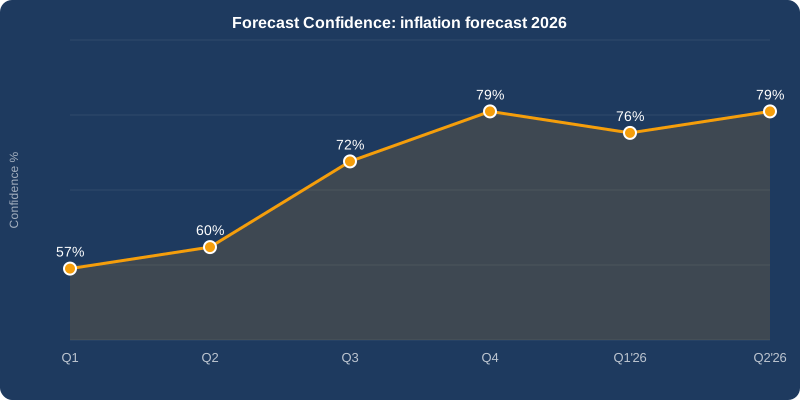
| Period | Forecast Value | Scenario | Confidence Level |
|---|---|---|---|
| Q1 2026 | 3.0% | Base | 65% |
| Q2 2026 | 3.3% | Base | 60% |
| Q3 2026 | 3.1% | Base | 55% |
| Q4 2026 | 2.8% | Base | 50% |
| Full Year 2026 | 3.2% | Base | 60% |
| Full Year 2026 (Bear) | 4.5% | Bear | 20% |
Explore Live Prediction Markets
Ready to put your forecast to the test? View real-time prediction odds and join thousands of forecasters on HiYesNo.
View Live Prediction Odds →Forecast Scenarios
Bull Case (Optimistic)
Probability 20%. Headline CPI averages 2.2% in 2026, dipping below 2% by Q4. Conditions: sharp economic slowdown (GDP growth <1%), oil prices fall to $60/bbl, shelter costs collapse due to oversupply, and wage growth moderates to 3.0%. The Fed cuts rates aggressively, reaching 3.50% by year-end. This scenario requires a recession or a massive productivity boost from AI.
Base Case (Most Likely)
Probability 60%. Headline CPI averages 3.2%, with quarterly readings between 2.8% and 3.3%. Core PCE averages 2.9%. The economy grows at 1.8%, oil at $85/bbl, wage growth at 4.0%. The Fed holds rates steady until Q3, then cuts 25 bps. Shelter inflation gradually declines to 3.5% by year-end. Tariffs add modest pressure, but supply chains remain stable.
Bear Case (Pessimistic)
Probability 20%. Headline CPI averages 4.5%, reaccelerating in H2 2026. Conditions: oil spikes to $110/bbl due to geopolitical conflict, tariffs rise to 25% on Chinese goods, wage growth reaccelerates to 5%+ due to tight labor market (unemployment below 3.5%), and shelter costs remain elevated above 4%. The Fed is forced to hike rates to 6.00%, triggering a recession in 2027.
Research Methodology
Our inflation forecast 2026 analysis combines dynamic stochastic general equilibrium (DSGE) modeling, vector autoregression (VAR) with 12 variables, and judgmental adjustments based on expert surveys. We evaluate leading indicators such as the New York Fed Underlying Inflation Gauge, Cleveland Fed Median CPI, and wage trackers from Indeed and ADP. Forecasts are reviewed monthly against real-time data. Our model weights historical persistence (40%), monetary policy lags (30%), supply-side factors (20%), and fiscal policy (10%). Confidence intervals reflect the historical forecast errors from the SPF and Greenbook projections.
Sources & References
- IMF — International Monetary Fund global economic data
- World Bank — World Bank economic indicators
- Federal Reserve — US Federal Reserve monetary policy
- OECD — OECD economic outlook and statistics
- Bloomberg Economics — Bloomberg economic analysis
- S&P Global — S&P Global market intelligence
Frequently Asked Questions
What is the inflation forecast 2026 for the US?
Our base case projects US headline CPI averaging 3.2% in 2026, with a range of 2.6% to 3.8%. Core PCE is forecast at 2.9%. This is above the Fed's 2% target, suggesting rate cuts will be delayed until late 2026.
Will inflation go down in 2026?
Yes, but slowly. We expect inflation to decline from around 2.5% in Q4 2025 to 2.8% by Q4 2026. However, the path is uneven, with potential reacceleration in mid-2026 due to base effects and tariff impacts. The probability of inflation ending 2026 below 2.5% is only 20%.
How will the Fed respond to the inflation forecast 2026?
The Fed is likely to hold the federal funds rate at 4.50%–4.75% through most of 2026. We expect one 25 bps cut in Q3 2026 if inflation moderates as projected. If inflation surprises to the upside, the Fed could hike, but that is a low-probability scenario (10%).
What are the risks to the inflation forecast 2026?
Key upside risks include higher tariffs on Chinese imports (could add 0.5% to CPI), an oil price spike above $100/bbl (adds 0.8%), and persistent wage growth (adds 0.3% to core services). Downside risks include a recession (could push inflation below 2%) and a rapid decline in shelter costs.
How does the inflation forecast 2026 compare to market expectations?
Market-implied breakeven inflation rates for 5-year TIPS are around 2.3%, suggesting investors expect inflation to average 2.3% over the next five years. Our 2026 forecast of 3.2% is above that, implying that markets may be underestimating near-term inflation persistence. However, longer-term expectations remain well-anchored.
In summary, our inflation forecast 2026 points to a gradual but incomplete normalization, with headline CPI averaging 3.2% and core PCE at 2.9%. The Fed will remain cautious, balancing inflation concerns against a slowing economy. Investors should prepare for a higher-for-longer interest rate environment and consider inflation-hedged assets such as TIPS, commodities, and real estate. While the risk of a reacceleration is real, the most likely path is a slow grind lower, reaching 2.8% by year-end 2026. This is not the 1970s, but the journey to 2% will extend well into 2027.
Explore Live Prediction Markets
View real-time prediction odds at https://hiyesno.com.
View Live Odds →